
Resource extraction operations across Canada’s northern territories face escalating security challenges demanding sophisticated countermeasures. Industrial camps, exploration sites, and remote construction projects require comprehensive protection extending beyond traditional fencing and guard patrols. Implementing professional camp security ensures uninterrupted operations, protects personnel, and safeguards valuable assets where emergency response times stretch into hours. As threats evolve, operators must embrace integrated technological solutions delivering seamless perimeter defense across challenging terrain and extreme weather conditions.
Why Seamless Perimeter Defense Matters
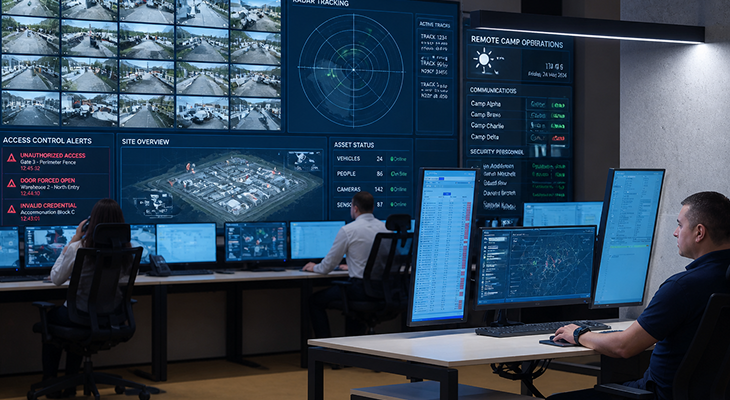
Fragmented security approaches create gaps that experienced intruders exploit with alarming ease. When access control systems, surveillance networks, and alert mechanisms operate independently, response times lengthen dramatically. Seamless camp security integrates every component into a unified ecosystem that communicates continuously and responds decisively to emerging threats.
Modern perimeter defense delivers quantifiable operational benefits:
- Reduction in security-related incidents through predictive analytics
- Decreased reliance on human observation in hazardous conditions
- Enhanced tracking of personnel movements across large sites
- Improved emergency response coordination with external agencies
- Lower overall security expenditure through technology optimisation
Advanced Surveillance for Northern Conditions
Extreme temperatures, prolonged darkness, and heavy snowfall impose severe demands on security equipment. Consumer-grade cameras fail rapidly under these conditions, creating dangerous coverage gaps. Professional camp security relies on military-specification hardware designed specifically for harsh environments.
Thermal imaging cameras detect human presence at significant distances regardless of lighting or weather conditions. These devices operate effectively through fog, snow, and complete darkness. Integrating thermal technology with artificial intelligence provides automated threat recognition that alerts control centres instantly.
Radar-based intrusion detection systems complement visual surveillance by monitoring large perimeter zones without requiring fixed camera placement. These systems penetrate dense vegetation and adverse weather, creating invisible detection corridors that identify movement patterns and track multiple targets simultaneously.
Key surveillance capabilities for remote camp environments include:
- Long-range thermal imaging effective beyond one kilometre in complete darkness
- Radar systems detecting movement through heavy precipitation and fog
- Artificial intelligence filtering wildlife activity to reduce false alarms
- Automated pan-tilt-zoom cameras responding to detected threats
- Redundant power systems maintaining operation during grid failures
Access Control and Identity Management
Managing personnel movement across sprawling camp environments demands sophisticated credentialing systems. Traditional key-card systems offer minimal security and create administrative burdens when rosters change frequently. Modern camp security implements biometric authentication combined with centralised identity management platforms.
Facial recognition technology now operates effectively in low-light conditions common at northern latitudes. Combined with physical access barriers, these systems create layered protection preventing credential sharing and tailgating incidents. Mobile credentialing applications allow managers to issue and revoke access permissions instantly.
Secure vehicle access presents additional challenges where supply deliveries occur regularly. Automated gate systems equipped with licence plate recognition and cargo screening protocols expedite legitimate traffic while preventing unauthorised entry.
Understanding Remote Camp Vulnerabilities
Remote industrial camps present unique security risks differentiating them from urban facilities. Geographic isolation, limited communication infrastructure, and significant material assets create attractive targets for theft, vandalism, and unauthorised intrusion. Weather-related access restrictions compound these vulnerabilities, sometimes leaving sites exposed for extended periods. Professional camp security strategies must account for these distinctive factors while maintaining operational efficiency.
Resource extraction companies operating in Alberta, British Columbia, and the Northwest Territories increasingly rely on comprehensive security frameworks integrating physical barriers, electronic surveillance, and rapid response protocols. The Government of Canada’s Critical Infrastructure Resilience guidelines provide essential frameworks for protecting essential services in remote environments, yet many operators fall short of implementing truly seamless protection systems.
Perimeter Intrusion Detection Systems
Physical barriers remain essential components of comprehensive camp security. Fencing, vehicle obstacles, and natural terrain utilisation create primary defense layers that slow or deter initial intrusion attempts. However, effective detection transforms passive barriers into active protective systems.
Fibre-optic sensing cables buried along perimeter lines detect vibration, pressure, and acoustic signatures associated with climbing, cutting, or vehicle approach. These systems achieve detection rates exceeding 95 per cent while maintaining extremely low false alarm frequencies. Artificial intelligence algorithms filter environmental noise caused by wildlife or weather.
Ground surveillance radar provides wide-area detection coverage identifying potential threats before they reach physical barriers. These systems track movement across kilometres of terrain, providing early warning enabling proactive response.
Critical detection technologies for perimeter protection include:
- Fibre-optic sensing cables detecting vibration and pressure signatures
- Ground surveillance radar tracking movement across expansive terrain
- Microwave intrusion detection creating invisible detection fields
- Seismic sensors identifying ground-based disturbances
- Acoustic monitoring detecting cutting, climbing, and vehicle approach
Communication and Emergency Response
Seamless security depends on reliable communication networks functioning independently of external infrastructure. Satellite-based connectivity ensures continuous communication between remote camps and regional coordination centres. Redundant systems maintain operational capability during extreme weather events.
Emergency response protocols require integrated notification systems reaching every individual on site simultaneously. Mass notification platforms combining public address, SMS messaging, and digital signage ensure personnel receive critical information regardless of location. Automated lockdown procedures secure vulnerable areas within seconds of threat detection.
Coordination with local law enforcement and emergency services demands standardised communication protocols. Security platforms interfacing with Public Safety Canada facilitate rapid resource deployment when incidents escalate beyond internal response capabilities.
Cybersecurity for Connected Camps
Integrated security systems depend on network connectivity creating potential cyber vulnerabilities. Industrial control systems, surveillance networks, and access databases represent attractive targets for malicious actors. Professional camp security must encompass both physical and digital protection measures.
Network segmentation isolates security infrastructure from administrative systems, preventing lateral movement by cyber intruders. Encrypted communications protect sensitive data transmitted between remote sites and central monitoring stations. Regular penetration testing identifies weaknesses before exploitation occurs.
Personnel training addresses social engineering risks bypassing technical controls. Security awareness programs educate workers about phishing attempts and suspicious digital activity that could compromise camp protection systems.
Implementation and Financial Benefits
Retrofitting comprehensive security systems into operational camps presents logistical challenges. Phased implementation strategies minimise operational disruption while delivering immediate security improvements. Prioritising high-risk perimeter zones ensures vulnerable areas receive protection first.
Temporary security deployments provide coverage during construction phases. Mobile surveillance towers, portable access control systems, and rapid-deployment barriers protect active areas while permanent infrastructure develops. Open architecture platforms accommodate legacy equipment while providing expansion capability.
Beyond threat prevention, professional camp security delivers measurable financial returns. Insurance premiums reflect risk profiles, with comprehensive protection attracting preferential rates. Reduced incident frequency lowers direct costs associated with theft and liability claims. Operational continuity represents the most significant financial benefit, as production stoppages caused by security incidents cost far more than prevention measures.
Conclusion
Seamless perimeter defense through high-tech remote camp security represents essential investment for resource extraction operations across Canada’s challenging environments. Integrating advanced surveillance, access control, intrusion detection, and communication systems creates comprehensive protection addressing evolving threats while supporting operational efficiency.
GPS Security Group delivers customised security solutions designed specifically for northern industrial camps, incorporating defence-grade technology with practical operational experience. Our integrated approach ensures seamless protection adapting to changing conditions and emerging risks. Contact our security specialists today to discuss your remote camp security requirements.