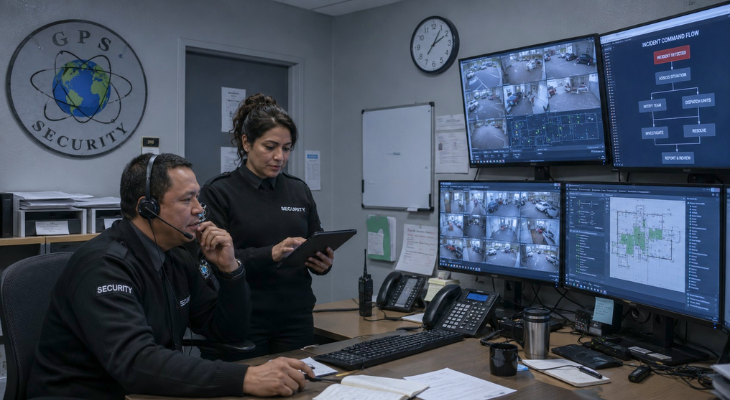
As Edmonton transitions from routine business operations to the high-stakes reality of an active threat, facility managers face a distinct imperative. Unlike jurisdictions with lower risk profiles, Edmonton’s evolving commercial landscape demands a security posture that is both reactive and pre-emptively structured. Implementing professional crisis management security before an incident escalates, preserves human life, protects assets, and ensures continuity of command during organisational duress.
How Operational Lapses Accelerate Crisis Conditions
During a security breach in an Edmonton corporate tower or industrial site, the interval between detection and counter-measure deployment determines the outcome. Without consistent crisis management security, response teams suffer decision paralysis and fragmented communication. When inadequate command structures combine with real-time threat vectors, confusion cascades through evacuation routes, delaying law enforcement handover and compromising liability controls.
Proactive crisis management security identifies these failures before a live event. Common indicators of deficient readiness include:
- A delayed radio response from floor wardens during drills
- Inconsistent access to live CCTV feeds from a central command post
- Evacuation marshals who cannot locate their assigned assembly areas
- Pre-written emergency scripts that contradict the current floor plan
Each defect is correctable during a routine audit. Left unaddressed, procedural gaps widen into systemic failure, leading to preventable casualties and regulatory sanctions.
Critical Deployment Protocols for Edmonton Facilities
For Edmonton businesses, a professional crisis management security programme must address three specific vulnerabilities, command escalation, inter-agency communication, and lockdown sequencing. GPS Security provides a systematic framework that moves beyond generic emergency binders.
Command Escalation and Incident Hierarchy
A security technician from GPS Security will first verify that your organisation maintains a clear chain of command during a critical incident. This includes designating primary and secondary incident commanders, establishing a secure internal communication channel, and programming automatic alerts to Edmonton Police Service. The Government of Canada’s Public Safety department, which oversees federal emergency management standards, recommends that private security protocols align with the Incident Command System used by Canadian first responders.
Inter-Agency Communication Integrity
Crisis management security depends on seamless data exchange between your private team and public emergency services. GPS Security tests radio interoperability, confirms cellular backup activation during primary network failure, and validates that digital mapping of your facility uploads correctly to responding units. Without this integration, Edmonton police lose precious minutes navigating unfamiliar floor plates.
Lockdown Sequencing and Reverse Evacuation
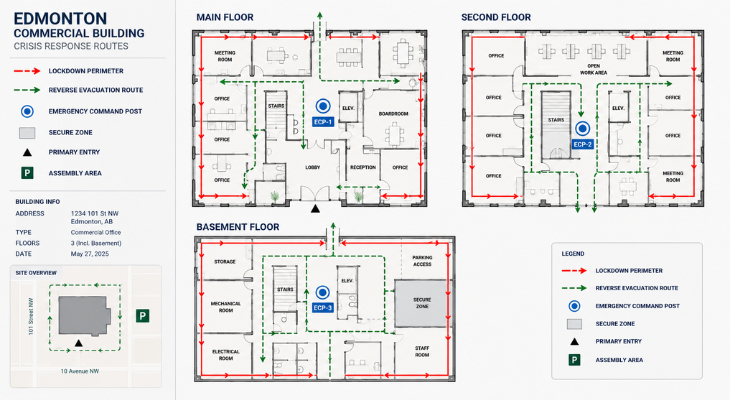
A poorly executed lockdown creates as much danger as no lockdown at all. GPS Security deploys graduated response protocols: shelter-in-place triggers for exterior threats, perimeter hardening for active intrusions, and reverse evacuation routing to move personnel away from danger zones.
Cost Avoidance Through Preparedness
An untested security apparatus forces executive leadership to make split-second decisions without verified intelligence. Post-incident litigation costs in Edmonton have exceeded seven figures for organisations unable to document reasonable crisis preparation. Conversely, a facility with professional crisis management security offers predictable performance:
- Pre-scripted actions reduce commander cognitive load by forty per cent
- Live integration with municipal alert systems accelerates police response
- Insurance liability premiums decrease following third-party verification
GPS Security documents all command drills with video audit trails, supporting legal defence strategies and enhancing stakeholder confidence.
The Risks of Deferred Security Implementation
Postponing a professional assessment until an active event occurs is a failure of fiduciary duty. Waiting for an intrusion or workplace violence incident often leads to secondary damage:
- Employee psychological trauma and subsequent absenteeism
- Regulatory investigations by Alberta Occupational Health and Safety
- Permanent brand degradation following public disclosure of negligence
In extreme cases, the absence of documented crisis management security voids commercial general liability policies, as many underwriters require proof of annual drill participation.
Professional Implementation With GPS Security
Edmonton security leaders require a partner who understands northern urban threats. GPS Security provides comprehensive crisis management programmes including live scenario simulations, red-team penetration testing, and post-incident forensic reconstruction.
A standard crisis deployment assessment includes:
- Mapping all ingress and egress points with ballistic-rated hold spaces
- Programming automated duress alarms for front-line reception staff
- Testing backup generator load capacity for security server rooms
- Inspecting lock-down barrier integrity on each floor
To ensure compliance with federal infrastructure standards, all work aligns with guidelines from Public Safety Canada. GPS Security follows all recommended protocols for critical infrastructure protection.
Conclusion
The operational demands of Edmonton’s commercial environment test every layer of private security. Deploying professional crisis management security transforms that challenge into an opportunity to harden assets and protect personnel. Do not wait for an active assailant alert or a regulator’s notice. Contact us today to schedule a full command-readiness assessment and secure a crisis plan designed specifically for the threat landscape of Northern Alberta.