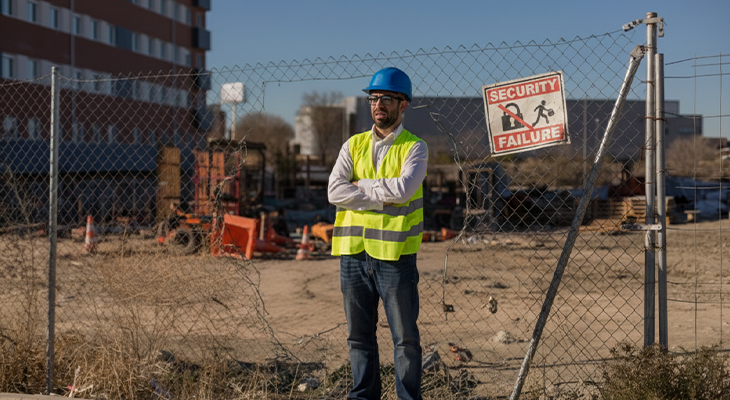
Construction sites are busy and of high value. These locations house expensive equipment and valuable materials. This makes them targets for theft, vandalism, and unauthorized access. Construction managers must treat site vulnerabilities as preventable issues.
Poor security leads to project delays, financial losses, and safety risks. These problems can ripple out to affect workers, insurers, and nearby communities.
Many site risks are predictable and repeat across construction projects. Strong risk assessment and early planning with a professional construction security company help identify and control these risks before incidents occur.
Government guidance confirms that a secure work site is designed to prevent, delay, and respond to unauthorized access to sensitive work sites and assets.
A secure work site is designed to prevent, delay and respond to unauthorized access to sensitive work sites, information and assets.
Why Construction Sites Face Unique Security Risks
Construction environments are temporary and constantly evolving. Site layouts change daily as different phases of work proceed. Open fences and gate gaps are common before final walls go up. With multiple contractors on site, responsibilities sometimes blur. These challenges create blind spots that criminals exploit.
Construction theft is not uncommon. Industry data shows that Canadian construction companies often lose tools, materials, and machinery to theft. Sometimes these losses go unrecovered because sites lack adequate security after hours.
Many Canadian companies experience multiple thefts every year. Approximately one car is stolen every six minutes in Canada.
This shows that property crime remains frequent and organized, making proactive security planning essential for protecting business assets and job sites.
Cause 1: Uncontrolled Access Points
Many sites have multiple entry points, especially early in a project. Temporary fencing often has gaps. These gaps invite trespassers. Workers may use different gates throughout the day. Without strict control, unauthorized people can enter unnoticed.
How to Prevent It
- Start by mapping all possible access points across the site.
- Close unused or unnecessary entry points to reduce exposure.
- Use access control measures at every active entrance.
- Staff trained security guards at checkpoints to verify credentials.
- Maintain entry logs to track movement and identify irregular access.
- Limiting access early helps prevent many security failures before they begin.
Cause 2: Lack of After-Hours Security Coverage
Most crimes at construction sites occur when work stops for the day. Overnight breaks are when trucks, tools, and materials are most vulnerable. If security is absent when crews leave, opportunistic theft increases.
How to Prevent It
- Implement round-the-clock surveillance and patrol coverage.
- Maintain a visible human presence to deter intruders effectively.
- Do not rely on warning signs alone for site security.
- Use a balanced mix of security guard patrols and surveillance technology.
- Design patrol routes that include both predictable and unpredictable patterns.
Cause 3: Over-Reliance on Cameras Without Human Oversight
Surveillance cameras are useful, but they are only part of the solution. Cameras record events, but they do not stop unauthorized entry on their own. Video footage alone cannot prevent theft in real time.
The use of video surveillance by private sector organizations must consider all less privacy-invasive means before resorting to video surveillance. This means your video strategy should protect safety without compromising privacy.
How to Prevent It
- Pair cameras with live monitoring services and defined response protocols.
- Review site activity in real time to enable immediate security action.
- Ensure security teams know when and how to escalate incidents.
- Establish clear privacy policies for all video monitoring systems.
- Confirm that the video use complies with applicable legal standards.
Cause 4: Poor Lighting in Critical Areas
Dark zones are a common weakness on many sites. Storage yards, raw material stacks, and machine sheds are easy targets without lighting. Thieves often stick to shadows and unlit routes to avoid detection.
How to Prevent It
- Install strategic lighting at key zones across the site.
- Use motion-activated lights to conserve power and improve detection.
- Ensure dark corners and storage areas remain visible after hours.
- Support mobile patrols with improved visibility along patrol routes.
- Enhance camera performance by providing consistent lighting coverage.
Cause 5: No Alarm Response Plan
Alarms without a structured response do little to stop incidents. If sirens sound and no one reacts, intruders have free rein until daylight.
How to Prevent It
- Ensure alarm systems are linked to a professional alarm response security team.
- Provide responders with clear instructions for each alarm type.
- Include procedures for breach alerts, tampering, and equipment alarms.
- Integrate alarm response into a broader site security plan.
- Define when police notification is required.
- Document all incidents properly to support insurance claims and reviews.
Cause 6: Inconsistent Security Procedures Between Contractors
A site with many subcontractors may lack cohesive rules. One company may secure materials well while another leaves gates open. These mixed practices invite breaches.
How to Prevent It
- Establish unified security procedures for all teams from day one.
- Include security expectations during contractor onboarding.
- Reinforce procedures during site orientation sessions.
- Provide clear access rules for all personnel.
- Define reporting lines for security concerns.
- Ensure everyone understands incident response protocols.
Cause 7: Failure to Adapt Security as the Project Progresses
Construction sites change rapidly. A security plan that works during ground preparation may no longer be adequate during interior fit-outs. When security stays static while the site evolves, vulnerabilities grow.
How to Prevent It
- Update the site risk assessment on a regular schedule.
- Adapt patrol routes as work areas change.
- Shift camera coverage when new assets arrive or depart.
- Review security priorities as the project progresses.
- Include security planning in weekly site meetings.
How Professional Security Helps Your Project Succeed
When construction sites invest in proper security, they protect their bottom line. Security guards enforce access control, manage alarms, and report suspicious behaviour. Mobile patrols extend coverage across large sites. Remote monitoring fills gaps when human presence is limited.
Security professionals also help enforce safety standards on-site. They document incidents, help coordinate emergency responses, and reduce liability exposure. When workers feel safer, productivity increases.
For managers wondering what level of security they need, a risk assessment by a qualified team is a smart first step.
About Us
GPS Security Group is a trusted provider of tailored security solutions for construction sites and commercial projects across Alberta and Western Canada.
We specialize in on-site security guards, mobile patrols, alarm response, and advanced surveillance solutions designed to prevent loss and protect your assets.
Construction and commercial clients can contact us to discuss a customized security plan that fits both the scale of your project and your risk profile.