
Across Canada, from downtown Toronto to suburban Vancouver, false alarms have become the silent adversary of genuine security. When emergency responders are dispatched to non-existent threats repeatedly, response times for real intrusions suffer. According to data from the Government of Canada’s Public Safety department, a significant percentage of police resources dedicated to alarm responses involve false activations. This is why professional false alarm detection services are no longer optional but a foundational requirement for any serious security infrastructure.
The True Cost of False Alarms
False alarms are not mere inconveniences. They erode the relationship between property owners, monitoring centres, and law enforcement. For commercial property owners, the consequences extend beyond public relations. Many Canadian municipalities enforce false alarm bylaw penalties, with fees escalating after each subsequent false activation within a calendar year.
Common consequences of repeated false alarms include:
- Accumulated fines exceeding hundreds or thousands of dollars annually
- Dangerous complacency where occupants ignore genuine alerts
- Strained relationships with local police services
- Potential suspension of police response privileges
GPS Security Group addresses this challenge directly by prioritising intelligent false alarm detection across all monitored installations, using verified technology to distinguish between genuine threats and environmental anomalies.
How Intelligent False Alarm Detection Works
Traditional security systems operate on a binary principle, a sensor triggers, and an alarm transmits. This model is inherently flawed because sensors cannot interpret context. A motion detector cannot differentiate between a forced entry and a balloon drifting across a showroom floor.
Intelligent false alarm detection solves this problem through multi-layered verification and signal processing. Instead of transmitting an alarm at the first moment of activation, modern panels evaluate additional data points before declaring an emergency.
Key verification methods include:
- Sequential Event Analysis: A perimeter activation requires a secondary interior sensor to confirm within a programmed time window.
- Cross-Zoning Logic: Two independent sensors must activate within a specific timeframe before generating a verified alarm.
- Cancellation Windows: Authorised users can quickly abort accidental triggers before dispatch occurs.
The Role of Video Verification
While sensor logic provides significant improvements, the most reliable form of false alarm detection incorporates visual confirmation. Video verification integrates high-resolution cameras with alarm processing, allowing monitoring station operators to see what triggered an event before requesting a dispatch.
When a sensor activates on a GPS Security Group monitored site, the system automatically retrieves video clips from the moments before, during, and after the trigger. A trained operator reviews this footage within seconds. If the video shows a service door left ajar by wind, the operator cancels the dispatch. If the footage reveals forced entry, the operator immediately requests emergency response with verified situational details.
This verification layer reduces false dispatches by an estimated 95 percent in properly configured installations. For Canadian property owners facing strict municipal false alarm bylaws, this reduction translates directly into avoided fines and preserved police relations.
Commercial Applications
Commercial environments present unique challenges for false alarm detection. Retail stores contend with hanging signage that confuses basic motion sensors. Warehouses face temperature differentials creating air currents capable of moving lightweight stock. Office buildings must accommodate cleaning staff without generating nuisance alarms.
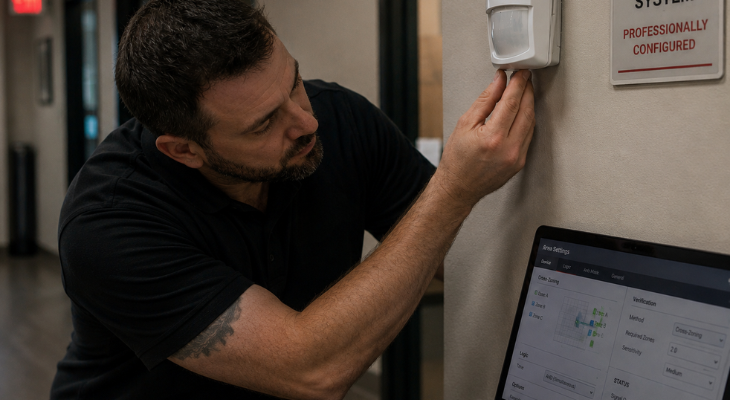
GPS Security Group approaches each commercial installation with tailored false alarm detection parameters. Site surveys identify environmental risk factors, including HVAC placement, wildlife access points, and vibration sources. Technicians then program panel logic to ignore predictable disturbances while maintaining sensitivity to genuine threats.
Long-Term Value
Implementing intelligent false alarm detection is not a set-and-forget exercise. Sensor alignment, environmental changes, and equipment aging all affect detection accuracy. GPS Security Group recommends bi-annual system audits where technicians review alarm logs, identify patterns of non-verified activations, and adjust parameters accordingly.
Property owners who invest in verified detection also benefit from reduced insurance premiums. Many Canadian commercial insurers recognise verified alarm systems as lower risk, offering premium discounts for installations that demonstrate consistently low false alarm rates.
Conclusion
GPS Security Group is a Canadian provider of professional security solutions, including monitored alarm systems, video surveillance, and access control. Your property’s security is only as reliable as your system’s ability to distinguish between a genuine intrusion and a harmless disturbance. Intelligent false alarm detection eliminates the nuisance, expense, and complacency caused by repeated false dispatches. Do not allow outdated binary detection to undermine your property’s safety. Contact us today to configure a verified detection system that performs with precision and professionalism.